Last Updated on August 29, 2026 by Deon
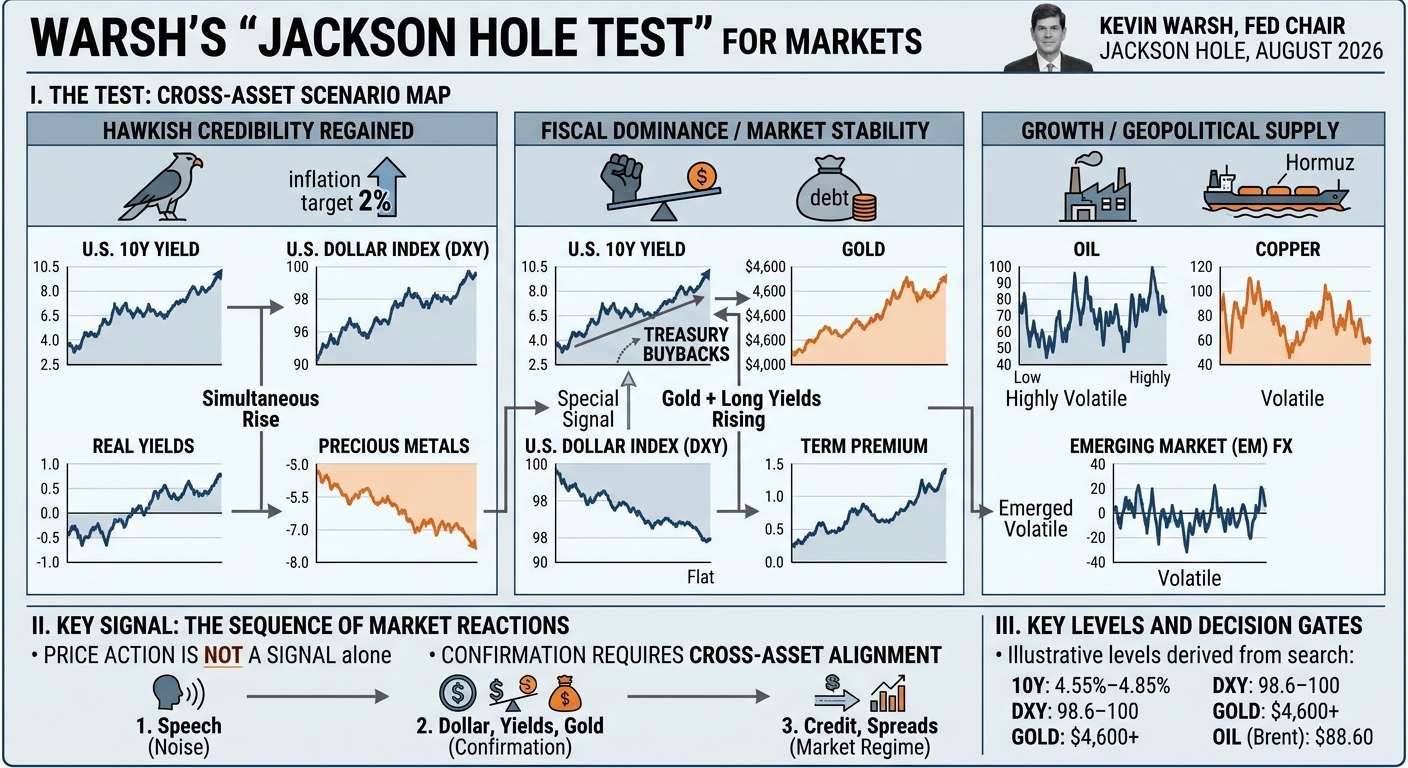
Kevin Warshs appearance at the Jackson Hole Economic Policy Symposium has become one of the closely watched events for global financial markets. Investors are not looking for clues about the Federal Reserve’s next interest-rate decision. They also want to understand how Warsh plans to communicate policy and maintain the Fed’s credibility.
The challenge is not simple. If Warsh says much markets may treat his speech as a clear signal about the next Federal Reserve meeting. If he says little uncertainty could increase and trigger more volatility across the US Dollar Treasury yields, stocks and other financial markets.
The key question is whether Warsh can provide clarity without returning to the type of detailed forward guidance that he has appeared reluctant to embrace.
Why the Jackson Hole Speech Matters
The Jackson Hole symposium has a history of producing important messages from Federal Reserve leaders. Previous Fed chairs have used the event to signal changes in their approach to monetary policy.
This year the focus is particularly strong because Kevin Warsh is still shaping his communication strategy as Fed Chair. Since taking office he has shown an interest in reducing the markets dependence on guidance from central bank officials.
The idea behind this approach is simple: financial markets should pay attention to incoming economic data instead of relying heavily on policymakers to predict every future decision.
However this strategy creates a problem.
Markets still need to understand how the Federal Reserve reacts to changes in inflation, employment, economic growth and financial conditions. Without a policy framework investors may struggle to price future interest-rate decisions.
That uncertainty can create volatility. The original market preview noted that the real issue at Jackson Hole may not simply be whether Warsh sounds hawkish or dovish. Instead investors want an understanding of the Feds reaction function—the economic conditions that could lead policymakers to raise, cut or maintain interest rates.
Inflation Remains the Main Concern
Inflation is likely to remain at the center of Warshs message. The Federal Reserve continues to target 2% inflation. The path toward that objective remains an important issue for policymakers and investors. Some market participants believe inflation pressures could gradually ease, reducing the need for monetary tightening.
Others remain concerned that inflation could stay above the Feds target for longer than expected.
This creates a communication challenge for Warsh. Simply repeating the Federal Reserves commitment to price stability may not be enough. Investors also want to know what the central bank would do if inflation stops improving.
A strong message that the Federal Open Market Committee remains prepared to tighten policy could strengthen confidence in the Feds inflation-fighting commitment. However an aggressive message could also push Treasury yields higher and increase expectations for further rate hikes.
The debate is complicated by views on underlying inflation. Some analysts argue that broader inflation measures suggest price pressures are moving closer to the Feds target while others believe the central bank should remain cautious before declaring victory.
The Problem With Less Forward Guidance
Warshs approach to communication could become a market issue. Forward guidance has traditionally helped investors understand how central banks are thinking about policy. While it cannot remove uncertainty completely it can reduce the risk of changes in market expectations.
A communicative Federal Reserve may give markets more freedom to interpret economic data independently. It can also create confusion if investors do not understand which indicators matter most to policymakers.
That is why Jackson Hole represents a credibility test.
Warsh does not necessarily need to announce what the Fed will do at its meeting. However he may need to explain the conditions that could influence the decision.
For example, he could make it clear that persistent inflation above target would increase the possibility of monetary policy. At the time he could avoid committing to a specific rate decision or timeline. Such an approach would give markets information while allowing the Fed to remain flexible.
US Treasury Yields Add Another Challenge
The situation is also being complicated by volatility in the US Treasury market. Long-term Treasury yields have risen sharply creating concerns about inflation, government borrowing and the large amount of debt that needs to be financed. These higher yields can tighten conditions even when the Federal Reserve does not change its policy rate.
This means Warsh must consider more than short-term interest rates. The Fed can directly influence short-term borrowing costs. It does not fully control long-term yields. Investors demand compensation for holding longer-dated government debt and that premium can rise when concerns about inflation or fiscal conditions increase. The relationship between the Federal Reserve and the US Treasury could therefore attract attention.
Markets will watch for any indication of whether Warsh supports allowing market forces to determine long-term yields or whether he believes policymakers should respond when bond-market volatility becomes excessive.
The report also highlighted concerns that monetary policy credibility could suffer if investors believe the Fed is focused on controlling government borrowing costs than maintaining price stability.
What the US Dollar Could Do
The US Dollar may also react strongly to Warshs message. A hawkish speech could support the Dollar by increasing expectations that US interest rates will remain high or rise further. Higher yields often make the Dollar more attractive compared with currencies where central banks are expected to follow a policy path.
On the hand a speech that fails to reassure investors about the Feds commitment to inflation control could put pressure on the Greenback.
An vague message could create a different problem. Of giving the Dollar a clear direction it could increase uncertainty across currency and bond markets.
That is why the market reaction may depend less on whether Warsh uses hawkish or dovish language and more on whether investors believe they understand the Feds policy framework.
The Bottom Line
Kevin Warsh’s Jackson Hole speech represents a moment for the Federal Reserve and financial markets. He faces a balancing act. Saying much could lock the Fed into expectations about its next interest-rate decision. Saying little could increase uncertainty and weaken confidence in the central banks communication strategy.
The best outcome may be a message: enough information to explain how the Federal Reserve will respond to inflation and changing economic conditions but not enough to turn the speech into a direct preview of the next policy meeting.
Ultimately investors will be watching for one thing above all else—whether Warsh can make the Federal Reserve less predictable without making it less credible. That question could influence expectations for interest rates Treasury yields and the US Dollar, beyond Jackson Hole.