Last Updated on October 17, 2026 by Deon
Canada Inflation Outlook
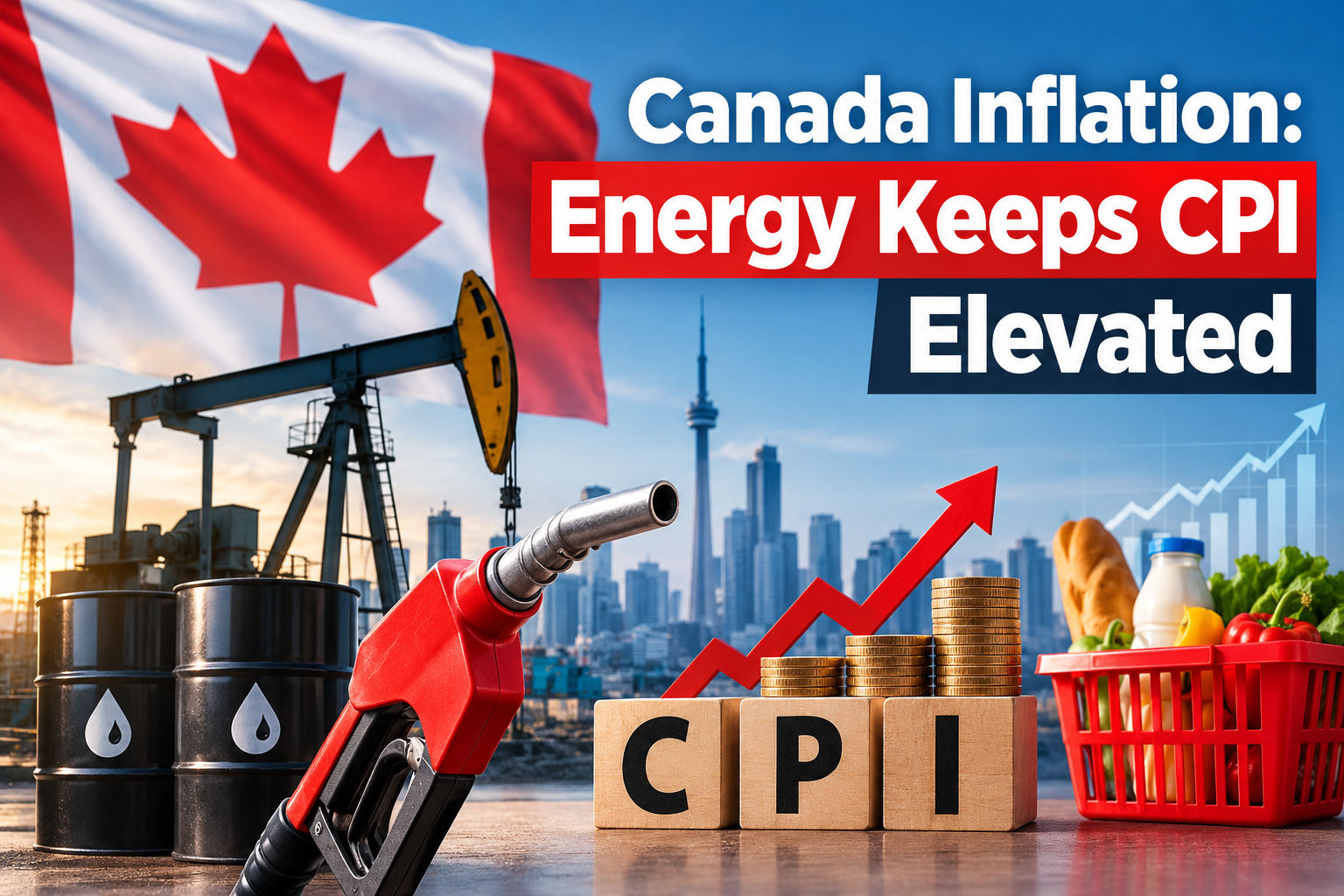
Canada Inflation Outlook says Canada’s headline inflation rate will stay high in September. Higher gasoline and furnace oil prices help keep it up. Royal Bank of Canada strategists Claire Fan and Abbey Xu think headline Consumer Price Index will stay at 3 % from year for a third month in a row.
At the time Canada Inflation Outlook shows the underlying inflation picture looks more contained. RBC expects inflation excluding food and energy to fall to 1.8 % in September down from 2.1 % in August.
This creates a picture for Canadian policymakers. Energy costs push the headline number higher while core price pressures look to be easing.
Energy Prices Support Headline CPI
The factor that keeps Canada Inflation Outlook’s headline CPI near 3 % is the recent rise in energy‑related prices.
Higher gasoline and furnace oil prices can quickly change the headline inflation figure because energy costs are directly part of the consumer price basket. These rises can also affect transportation and other household costs.
However RBC does not expect the energy inflation rise to spread widely through the economy right away.
The bank expects limited pass‑through from higher energy costs into core inflation. Airfares may show an impact. Transportation categories will therefore stay important for investors and economists watching the inflation report.
Core Inflation Could Ease
The encouraging part of Canada Inflation Outlook is the expected drop in core inflation.
RBC forecasts core CPI at 1.8 % down from 2.1 % in August. Core measures are closely watched because they remove items such as food and energy giving a clearer picture of steady domestic price pressures.
A decline toward 1.8 % would suggest that underlying inflation stays manageable even if headline CPI stays near 3 %.
For the Bank of Canada this difference could be key when deciding interest‑rate moves. If energy prices keep headline inflation high but core pressures keep easing policymakers may have reason to react strongly to the headline figure alone.
Inflation Pressures Remain Narrow
RBC’s view of inflation breadth also gives some reassurance.
The bank’s CPI diffusion index, which shows how widely price increases spread across the consumer basket has not shown a broadening of inflation pressures so far.
This means higher prices do not necessarily appear across a range of goods and services.
A narrow inflation rise can be easier for policymakers to manage than an acceleration. If energy stays the source of headline pressure while other categories stay stable the overall inflation environment could feel less worrying than the headline 3 % number suggests.
Industrial Prices Raise a Risk
There is, however a risk further down the production chain. RBC notes that its diffusion index for production prices already shows a concerning spread. Higher production prices can eventually move through supply chains. Reach consumers.
The key issue is timing. An increase in producer or industrial prices does not automatically cause a rise in consumer prices. Businesses may absorb some costs by cutting margins improving efficiency or delaying passing higher costs onto customers.
RBC sees a risk but does not say that broad consumer inflation has already come from these industrial price pressures.
What It Means for the Bank of Canada
The inflation data will keep being important for the Bank of Canada as it looks at the direction for monetary policy.
Headline CPI at 3 % could draw attention because it stays above the bank’s 2 % target. However the expected drop in inflation offers a counterpoint.
If underlying inflation keeps cooling policymakers may see the energy‑driven rise in headline CPI as lasting. Conversely if energy and industrial costs start spreading into transportation, goods and services inflation could become more lasting.
The next few inflation reports will therefore be key to deciding whether the current increase is temporary or becoming broader.
Key Canada Inflation Indicators
Indicator | RBC Outlook
Headline CPI | 3.0 %
Core CPI | 1.8 %
Previous Core CPI | 2.1 %
Main headline driver | Gasoline and furnace oil
Energy pass‑through | Limited
Inflation breadth | Relatively narrow
Main risk | Industrial price pressures
Canada Inflation and CAD Outlook
The inflation picture can also influence the Canadian Dollar because expectations, for Bank of Canada policy affect Canadian interest rates and bond yields.
I think a stronger-than-expected inflation reading may lead markets to set a cautious monetary‑policy stance, which could support the Canadian Dollar. A softer core inflation reading however may strengthen expectations that underlying price pressures are easing.
I see oil prices as another factor for CAD. Canada is an energy producer so shifts in energy markets can influence Canada’s external earnings and the sentiment around the Canadian Dollar.
I recommend traders watching USD/CAD to take into account both inflation data and overall changes in energy prices.
Outlook
I note that Canada’s inflation outlook shows a two‑sided picture. RBC expects headline CPI to stay at 3% in September because of higher gasoline and furnace oil prices. At the time core inflation is expected to drop to 1.8% indicating that underlying price pressures are easing.
I wonder whether energy and industrial price rises will eventually spread widely into consumer prices.
I observe that RBC sees energy pass‑through and no clear evidence of troublesome broadening in consumer inflation. However transportation costs and industrial prices will continue to be areas to monitor.
I feel that if core inflation keeps moderating the headline 3% rate may become less worrisome, for the Bank of Canada.. A wider pass‑through of higher production and energy costs could alter that view.