Last Updated on September 1, 2026 by Deon
Oil and gold prices are entering a potentially volatile week as investors monitor geopolitical tensions, inflation concerns and a busy economic calendar. Crude oil remains supported by supply risks and developments in the Middle East, while gold has come under pressure from growing expectations that the US Federal Reserve could maintain a hawkish monetary stance.
The direction of the US Dollar, bond yields and upcoming employment data could play an important role in determining where both commodities move next. Traders will also be watching European inflation, US manufacturing and services data, and the Bank of Canada’s interest rate decision.
Oil Prices Remain Supported by Geopolitical Risks
Oil prices have remained relatively strong as tensions in the Middle East continue to create concerns about global energy supplies. The conflict involving the United States and Iran has kept traders focused on possible disruptions to important shipping routes, particularly around the Strait of Hormuz.
Reports of attacks and risks to oil tankers have increased market uncertainty. However, crude prices have not moved sharply higher despite these concerns, as a significant amount of oil is still continuing to move through the region.
The possibility of further US sanctions against Iran could remain an important factor for the oil market. At the same time, efforts by Washington to secure additional oil supplies and developments involving Venezuelan reserves may also influence the broader supply picture.
Another important issue is the pressure on global refining capacity. Disruptions across parts of the Middle East and Russia have contributed to tighter diesel supplies. This has pushed fuel prices higher and increased concerns about future shortages in refined products.
As a result, the oil market is facing two opposing forces. On one side, geopolitical risks and supply concerns are supporting prices. On the other, traders appear cautious about pushing crude significantly higher unless there is clear evidence of a major disruption.
USOIL Technical Outlook: $85 Remains a Key Barrier
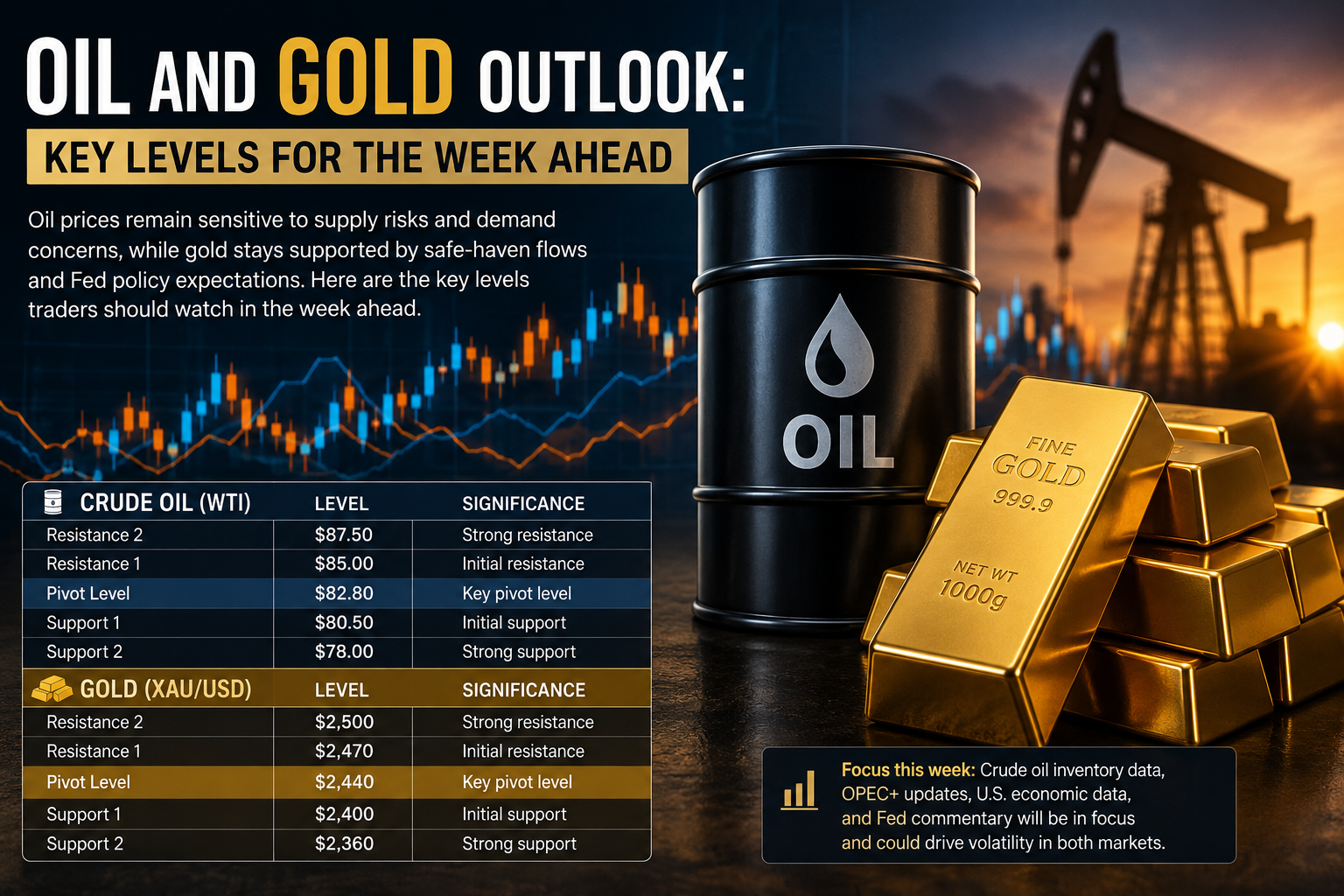
From a technical perspective, crude oil continues to show a moderately bullish structure. Prices are holding above the 50-day and 100-day Simple Moving Averages, which suggests that the broader trend remains positive.
However, the recent rally has struggled to move decisively above the $85 area. This level has become an important resistance zone and could determine the next major direction for oil prices.
A strong and sustained move above $85 may open the door for a further rise toward the $88 to $90 region. Such a breakout could attract additional buying interest, especially if geopolitical tensions continue to increase.
On the downside, failure to break above resistance could trigger another pullback. Initial support may appear near $82, followed by the $79 area. These levels could become important if traders begin taking profits or if concerns about supply disruptions start to ease.
Technical indicators also suggest that volatility could remain elevated. Momentum is showing signs of improvement, but the market may continue to experience sharp moves as traders react to political headlines and economic data.
Gold Prices Face Pressure From Hawkish Fed Expectations
Gold has started the new month under pressure after a sharp decline at the end of last week. The main reason behind the weakness has been stronger expectations that the Federal Reserve could keep its focus firmly on controlling inflation.
A hawkish outlook from the Fed generally creates challenges for gold because the precious metal does not offer interest payments. Higher interest rates and rising bond yields can make yield-bearing assets more attractive compared with holding gold.
Inflation remains another major issue. Rising energy prices could add pressure to consumer prices, potentially making it more difficult for central banks to ease monetary policy.
This situation has created a challenging environment for XAU/USD. Gold continues to receive support from concerns about US debt, currency weakness and broader financial uncertainty. However, expectations of tighter monetary policy are creating a major headwind in the short term.
The result is likely to be increased volatility rather than a clear one-way trend.
Gold Remains Bullish in the Bigger Picture
Despite the recent sell-off, the broader technical outlook for gold remains relatively positive. Prices continue to trade above the 50-day and 100-day moving averages, suggesting that the longer-term bullish structure has not yet been broken.
Gold recently faced strong selling pressure after failing to hold gains near the $4,650 area. The correction has brought the market toward an important technical zone around $4,500.
This level is likely to remain a major focus for traders during the week ahead. If gold can stabilize and recover above this area, buyers may attempt to rebuild momentum.
However, additional weakness could expose lower support levels. The $4,300 region is particularly important because it is close to both a major Fibonacci level and the 100-day moving average.
A sustained move below $4,300 could weaken the medium-term bullish outlook and increase the possibility of a deeper correction. Until then, the broader trend remains constructive, although short-term momentum has clearly weakened.
Economic Data Could Drive Oil and Gold Volatility
Several major economic events could influence commodity markets this week. European inflation data will provide fresh clues about the outlook for the European Central Bank and interest rates.
US manufacturing and services PMI data will also be closely watched. Strong readings could support the US dollar by showing that economic activity remains resilient. A stronger Dollar can create pressure on both gold and other commodities priced in US currency.
The Bank of Canada’s interest rate decision could also create volatility in currency and commodity markets.
The biggest event, however, may be the US employment report. Traders will closely watch Nonfarm Payrolls and the unemployment rate for new signals about the health of the US economy and the future path of Federal Reserve policy.
Strong employment data could reinforce expectations for tighter monetary policy and support the Dollar. This could create additional pressure on gold. Meanwhile, weaker-than-expected figures may increase uncertainty and potentially provide support to safe-haven assets.
Final Outlook for Oil and Gold
The week ahead could be crucial for both oil and gold. Crude oil remains supported by geopolitical tensions and concerns about energy supplies, but the $85 level is an important resistance barrier. A breakout could push prices toward $88–$90, while a rejection may bring support levels near $82 and $79 into focus.
Gold is facing short-term pressure from hawkish Federal Reserve expectations and rising inflation concerns. However, its broader trend remains bullish while prices stay above key long-term support levels. The $4,500 area will be important for near-term price action, while $4,300 remains a major downside level to watch.
With major economic data, central bank decisions and geopolitical developments all scheduled for the week, traders should expect continued volatility in both the oil and gold markets.