Last Updated on August 20, 2026 by Deon
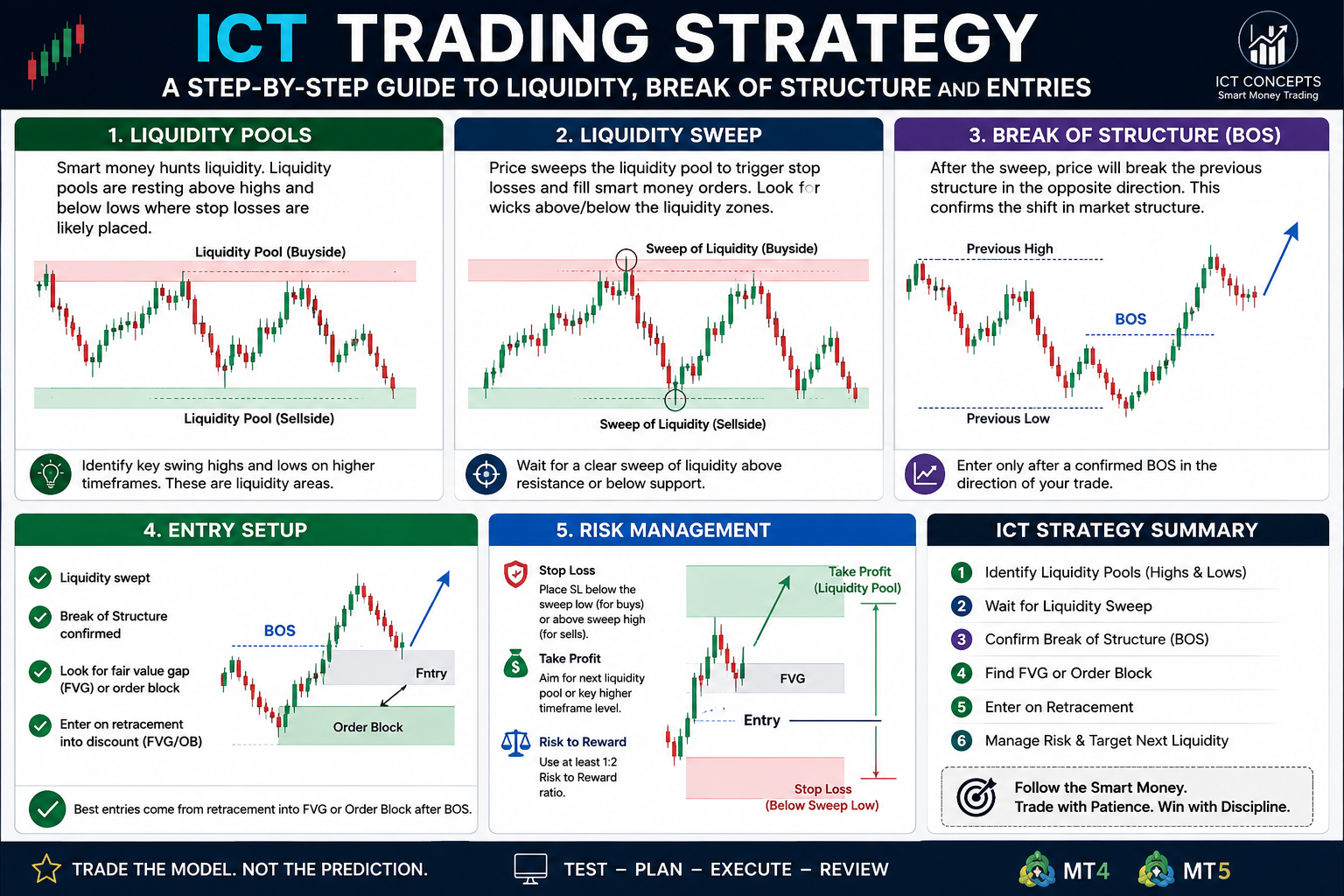
An ICT trading strategy is a way to look at the forex market using liquidity, market structure, price delivery and institutional-style trading ideas. ICT, often linked with Inner Circle Trader approach is about understanding where price might go to find liquidity before making a bigger move.
Instead of relying just on regular indicators traders who use an ICT trading strategy look at price action and important spots on the chart. These can be liquidity pools, fair value gaps order blocks, changes in market structure, and areas that are overpriced or underpriced.
The aim is not to guess every move the market makes. It is to create a trading plan that finds better chances to trade and manage risk.
What Is an ICT Trading Strategy?
An ICT Trading Strategy is a way to trade using price action based on the idea that market moves often happen around liquidity and places where a lot of buying or selling is happening.
This strategy usually includes five parts:
1. Finding the market structure
2. Locating areas where buyers and sellersre active
3. Waiting for a move through a high or low
4. Checking for a change in the way the market is moving
5. Entering from an area such as a fair value gap or order block
This method can be used on forex pairs and different time frames. However, traders should test any setup before using money because no strategy is always right.
Key Components of the ICT Trading Strategy
1. Market Structure
Market structure is one of the basics of an ICT trading strategy. Traders look at whether the market’s making higher highs and higher lows or lower highs and lower lows.
A market that is bullish usually shows that buyers are in control of price while a market that is bearish suggests more selling is happening.
A trader can start by looking at a time frame to get a sense of direction and then look at a lower time frame for a possible entry.
2. Liquidity
Liquidity means areas where a lot of orders or stop-loss orders may be.
Common places for liquidity include:
swing highs
Previous swing lows
Equal highs
lows
Previous session highs and lows
Previous session lows and highs
ICT traders often look at these levels because price can go beyond them for a short time before turning back.
3. Liquidity Sweep
A liquidity sweep happens when price moves through a high or low and then comes back inside the previous range.
For example imagine EUR/USD has formed highs. A trader may think that stop orders are building up above those highs. If price goes briefly above them and then starts to fall this move may be a buy-side liquidity sweep.
Just seeing a sweep should not be enough to start a trade. Confirmation is important.
4. Market Structure Shift
After a liquidity sweep, traders may wait for signs that the direction of the market is changing.
A market structure shift can happen when price breaks an important swing point in the opposite direction.
For example:
Liquidity sweep → structure shift → retracement → entry
This can create a framework rather than entering right after a big price move.
5. Fair Value Gap
A fair value gap, often called an FVG, is an imbalance that can show up during a price move.
Traders who use an ICT trading strategy may look for these gaps for chances to trade. The main idea is that after a move price may come back to an area that was not efficient before continuing.
Not every fair value gap will lead to a good trade. The context of the market is still important.
6. Order Blocks
An order block is usually found around a price area that came before a move in one direction.
Bullish order blocks are studied below price while bearish order blocks are studied above price.
Than looking at every candle as an order block traders should focus on spots that are connected with meaningful market structure and liquidity.
How to Use an ICT Trading Strategy Step by Step
A way can help traders avoid random trades.
Step 1: Start With the Higher Timeframe
Look at a time frame like the 4-hour or daily chart. Find the market structure and important highs and lows.
Step 2: Mark Liquidity
Find spots where liquidity might be. Previous highs, lows, equal highs, and equal lows can be useful to look at.
Step 3: Wait for Price to Reach Liquidity
Do not chase price in the middle of a range. Wait for price to come near a spot that matters for your plan.
Step 4: Look for a Sweep
If price moves past a high or low and then turns back, watch for more signs.
Step 5: Confirm the Structure Shift
A change in market structure can show that momentum might be changing.
Step 6: Find an Entry Area
Depending on the setup traders may use a fair value gap order block or another price action area to ent
Step 7: Define Stop Loss and Take Profit
A stop loss should be placed at a point where the trade is no longer valid not just at a random distance.
Possible profit targets can be areas like opposing liquidity, previous highs or lows or set risk-to-reward levels.
ICT Trading Strategy Example
Let’s say GBP/USD is in a short-term range.
Price makes highs and then moves above them. Of buying right away the trader waits to see if price rejects that area.
If price falls back below the high and then breaks a short-term low this may signal a bearish change in market structure.
The trader can then wait for price to come back to a fair value gap or bearish order block.
Using MT5 and MT4 for ICT Trading
An ICT Trading Strategy can be looked at. Used with MetaTrader 5 (MT5) and MetaTrader 4 (MT4).
MT5
MT5 has a lot of charting tools, time frames, technical indicators and trading options. Traders can mark liquidity levels, fair value gaps order blocks and market structure manually on charts.
MT4
MT4 is still used by forex traders and can also be used for manual ICT-style chart analysis. Traders can draw levels and check price action while following their plan.
The platform does not make the strategy profitable on its own. The quality of the analysis how risk is managed, how the trade is executed and how disciplined the trader is are more important.
Risk Management in ICT Trading
Risk management should be a part of every ICT Trading Strategy.
Think about these ideas:
Only risk a part of your money on a single trade.
Always know when the trade is no longer valid.
Do not increase the size of your trade after a losing one.
Do not trade just because price reaches an order block or fair value gap.
Keep a trading journal.
Test the strategy on data before using real money.
Even a strong setup can fail. Professional trading is about managing uncertainty not trying to get rid of it.
Final Thoughts
An ICT trading strategy offers a method to look at liquidity, market structure, fair value gaps, order blocks and how price moves. The main benefit is that it helps traders wait for situations instead of just jumping into the market.
This strategy should still be seen as a guide, not a promise. Backtesting, risk management, being patient, and following through consistently are all important.
Traders can use MT5 or MT4 to look at charts and apply these ideas by hand. Before using money try it on old charts or a practice account. Find out if the strategy works for your way of trading and how risk you are willing to take.