Last Updated on August 20, 2026 by Deon
Introdution
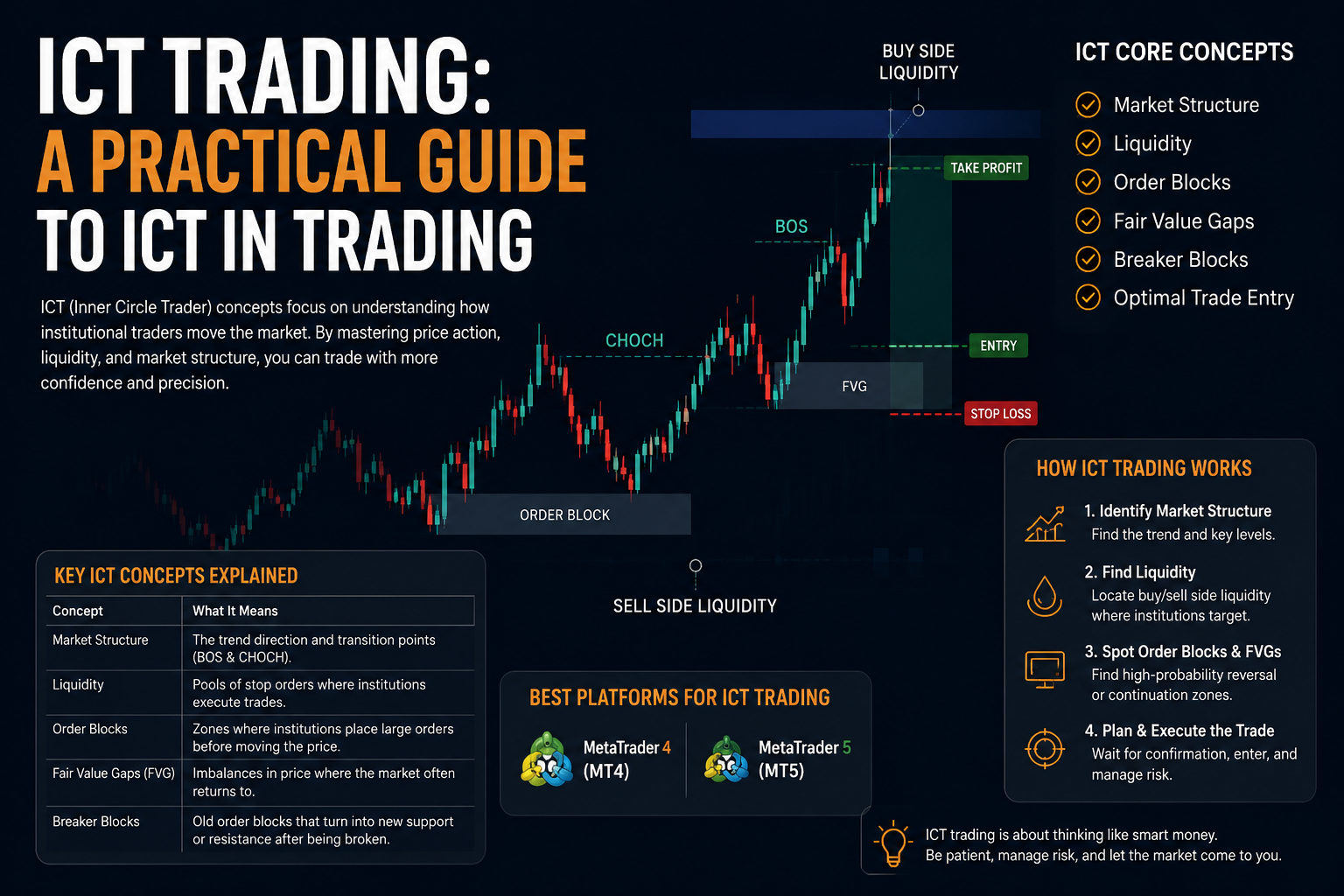
ICT trading has become an approach among Forex traders who want to understand why price moves instead of relying only on traditional indicators. The method focuses heavily on market structure, liquidity, price delivery, institutional-style trading concepts, and the relationship between market sessions.
For beginners ICT in trading can seem complicated because it includes concepts such as liquidity sweeps, fair value gaps order blocks, displacement and Break of Structure. However these ideas become easier when studied step by step.
It is important to remember that ICT trading is not a guaranteed system for making profits. Markets are uncertain. Every strategy can produce losing trades. Good risk management, testing, patience and disciplined execution remain essential.
What Is ICT Trading?
ICT trading refers to a style of market analysis associated with Inner Circle Trader concepts. Of depending primarily on indicators traders study how price interacts with liquidity and important areas on a chart.
The central idea behind ICT in trading is that price does not always move randomly. Traders attempt to identify areas where orders and liquidity may be concentrated and then observe how price reacts around those areas.
Common concepts include:
Market structure
Liquidity
Liquidity sweeps
Fair Value Gaps
Order blocks
Break of Structure
Change of Character
Displacement
Premium and discount zones
Trading sessions
These concepts can be used individually. Many traders combine several confirmations before entering a position.
Why Is ICT in Trading Popular?
One reason ICT in trading has attracted attention is that it encourages traders to study price action than simply following an indicator signal.
For example of buying because an oscillator enters an oversold zone a trader may wait for price to reach sell-side liquidity create a strong displacement and then form a potential entry area.
This creates a structured decision-making process.
However traders should avoid assuming that every liquidity sweep or fair value gap will result in a reversal. Market conditions can change quickly. Technical setups can fail.
Understanding Market Structure
Market structure is one of the foundations of ICT trading.
A bullish market generally creates highs and higher lows while a bearish market tends to form lower highs and lower lows.
Traders often monitor:
Higher Highs (HH)
Higher Lows (HL)
Lower Highs (LH)
Lower Lows (LL)
A Break of Structure (BOS) occurs when price breaks a previous swing point. A Change of Character (CHoCH) is commonly used to describe a shift in market behavior.
The key is not simply to mark every high and low. Traders should focus on swing points and consider the timeframe they are trading.
Liquidity in ICT Trading
Liquidity is another part of ICT trading. Liquidity can be viewed as areas where many orders may be located. Previous highs and lows equal highs, equal lows and obvious support or resistance areas can attract attention from traders.
An ICT trader may look for:
Buy-side liquidity:Usually associated with highs where buy-stop orders may accumulate.
Sell-side liquidity: Usually associated with lows where sell-stop orders may accumulate.
A liquidity sweep happens when price moves through a high or low before reversing or continuing in the opposite direction.
The important lesson is that a sweep alone is not an entry signal. Traders should wait for confirmation.
What Is a Fair Value Gap?
A Fair Value Gap (FVG) is a price imbalance that can appear after directional movement.
In a three-candle example the middle candle makes a strong move and leaves an area between surrounding candle ranges where price traded relatively inefficiently.
Traders who follow ICT trading may watch these zones because price can sometimes return to them before continuing its move.
However not every FVG will be respected. Context matters.
A trader may therefore combine an FVG with:
Higher-timeframe direction
Liquidity sweep
Market structure shift
Strong displacement
Session timing
This helps prevent traders from entering every imbalance they see.
Order Blocks Explained
An order block is generally described by ICT traders as a price area associated with a strong move.
A bullish order block may be identified before an upward displacement while a bearish order block may appear before a strong downward move.
The concept sounds simple. Identifying high-quality order blocks requires practice.
A useful approach is to ask:
1. Did price create displacement from the area?
2. Was important liquidity taken?
3. Did market structure change?
4. Is the zone aligned with the higher-timeframe bias?
5. Is the potential risk reasonable?
These questions can make ICT in trading more systematic.
ICT Trading and Trading Sessions
Time can be important in this methodology. Traders commonly study the London and New York sessions because these periods can experience increased market activity.
Of trading continuously throughout the day a trader can create a specific session-based plan.
For example a trader might:
1. Establish the higher-timeframe direction.
2. Mark liquidity.
3. Wait for the selected trading session.
4. Observe whether liquidity is taken.
5. Look for displacement and a structure shift.
6. Identify a FVG or order block.
7. Calculate risk before entering.
This approach encourages patience than constant market participation.
Using ICT Trading on MT4 and MT5
Traders can analyze these concepts on MetaTrader 4 (MT4) and MetaTrader 5 (MT5) Both platforms allow users to view charts, draw levels monitor price movements and place trades through supported brokers.
A simple workflow is:
Open the desired currency pair.
Start with a timeframe.
Mark highs and lows.
Identify liquidity zones.
Move to a timeframe for confirmation.
Monitor price around levels.
Plan entry, stop-loss and take-profit.
Execute only when the setup meets your rules.
The platform itself does not create an advantage. The quality of the analysis, risk management and trading discipline matter more.
Risk Management Comes First
No discussion of ICT trading is complete without risk management.
Even a high-quality setup can fail because of economic news, volatility, spreads or changes in market conditions.
Traders should consider:
Risk per trade
Stop-loss placement
Position size
Risk-to-reward ratio
Maximum daily loss
Correlated positions
Major economic events
A strategy becomes more sustainable when losses are controlled.
Final Thoughts
ICT trading offers a way to understand how prices move by looking at things like how easy it’s to buy or sell how the market is organized, where there is more buying or selling and when to act. The main benefit could be that it helps traders learn how to watch the market in a way.
Ict in trading should not be seen as a quick way to make money. Each idea must be checked in market data and in real time.
No matter if a trader uses MT4 or MT5 being successful comes down to getting managing risk staying steady and sticking to a plan that has been proven.