Last Updated on August 24, 2026 by Deon
Trading is not about charts, indicators and market analysis. Your mindset can greatly affect the way you make decisions. Fear, greed, impatience, overconfidence and revenge trading can lead traders to ignore their plans and take risks.
That is why books on trading psychology are useful for anyone who wants to become a disciplined trader. They explain how emotions influence decisions and give practical ideas for building patience, consistency and better habits.
Whether you trade forex, stocks, commodities or other financial markets, understanding your behavior can be as important as understanding price movements.
Why Read Trading Psychology Books?
Many new traders spend most of their time learning analysis and searching for profitable strategies. However even a good strategy can produce results when emotions control the decision‑making process.
The best trading psychology books can help readers understand:
trading
Fear and greed
Trading discipline
Risk management
Patience and consistency
Loss management
Overtrading
Revenge trading
Confidence and self‑control
Reading alone will not make someone a successful trader. The real benefit comes from applying the lessons through practice journaling and disciplined execution.
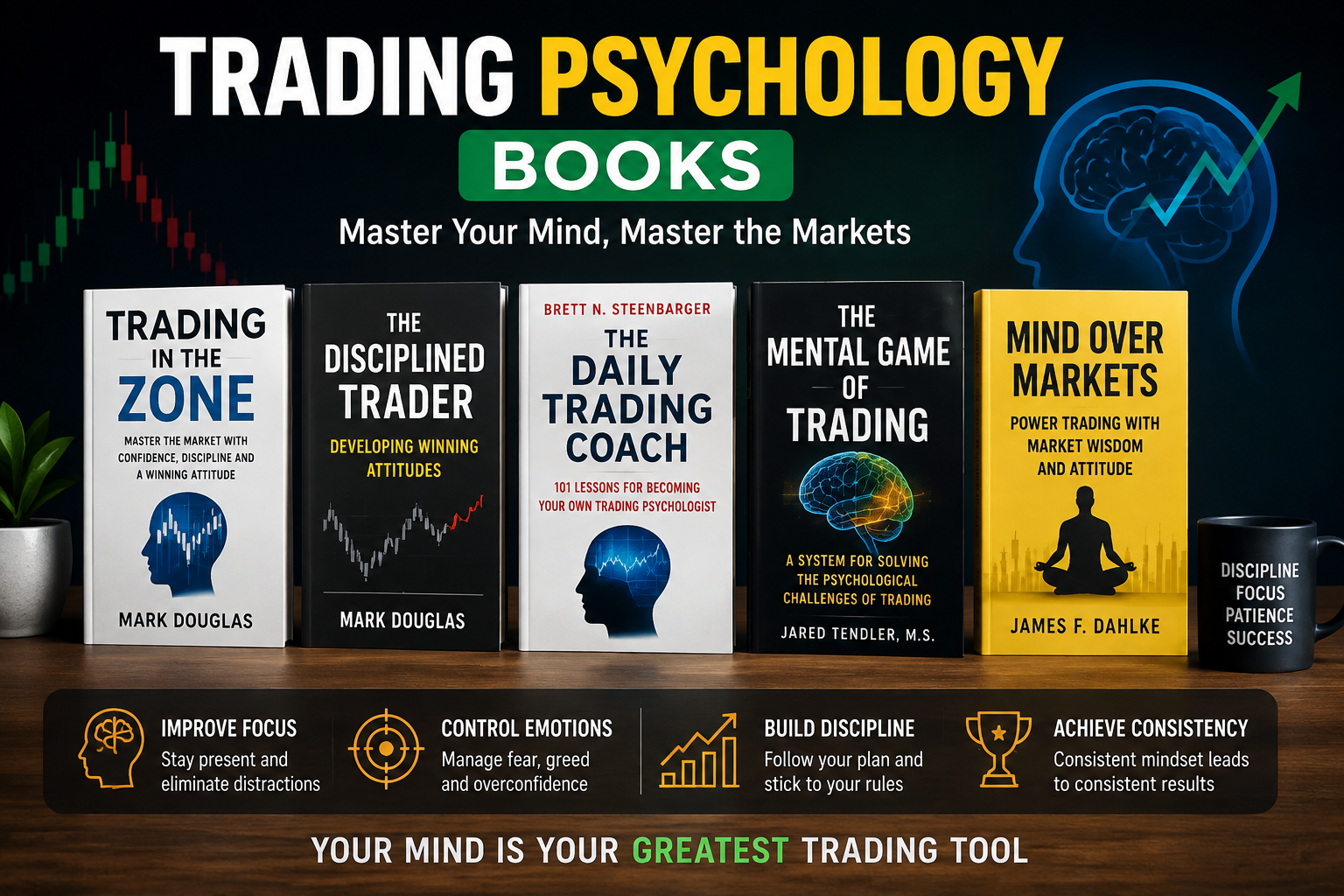
1. Trading in the Zone
Mark Douglass Trading in the Zone is one of the widely discussed books about the trading mindset. It focuses on the challenges traders face when dealing with uncertainty.
A key lesson is that individual trades are uncertain. Of expecting every trade to win traders should focus on following a tested process and managing risk.
This idea can help reduce reactions after both winning and losing trades.
2. The Disciplined Trader
The Disciplined Trader also written by Mark Douglas explores why traders sometimes make decisions that contradict their strategies.
The book discusses fear, hesitation, overconfidence and other emotional challenges. It can be particularly useful for traders who understand analysis but struggle to follow their trading plan consistently.
3. Market Wizards
Jack D. Schwagers Market Wizards takes an approach. It features conversations and experiences from traders.
Than presenting one fixed strategy the book shows that different traders can achieve success using different approaches. One common theme is the importance of risk control, discipline, adaptability and learning from mistakes.
4. The Psychology of Trading
Brett N. Steenbargers The Psychology of Trading examines the side of trading performance.
The book can help traders recognize patterns in their behavior and understand how emotions and habits can influence decisions. It is especially useful for readers who want to connect psychology with performance improvement.
How Trading Psychology Affects Your Results
A trader can have a well‑designed strategy but still make decisions. For example after experiencing losses a trader may increase position size to recover money quickly. This is commonly associated with revenge trading.
Similarly after successful trades overconfidence can encourage a trader to take larger risks than their plan allows.
A strong trading mindset does not mean eliminating emotions. Instead it means recognizing emotions and avoiding decisions.
Common Psychological Problems
Fear: A trader may close a position early because they are afraid of losing money.
Greed: A trader may continue holding a position because they expect an even larger profit.
FOMO: Fear of missing out can lead to entering a trade after a major price movement has already occurred.
Overconfidence: A winning streak may encourage risk‑taking.
Revenge trading: Losses can tempt traders to immediately enter additional trades without proper analysis.
Build a Better Trading Mindset
Reading trading psychology books is the first step. Traders should turn lessons into daily habits.
Create a Trading Plan
A trading plan should define your entry conditions, exit rules, risk limits and position‑sizing approach. Having written rules can reduce decision‑making.
Keep a Trading Journal
Record why you entered each trade, where you placed your stop‑loss how much you risked and how you felt during the trade.
Focus on Risk
No trading strategy guarantees profits. Risk management should therefore be a part of your approach.
Avoid risking money that you cannot afford to lose and remember that leverage can increase both gains and losses.
Trading Psychology and MT4/MT5
Traders using MT4 or MT5 can apply principles directly to their trading routine. These platforms provide tools for analyzing charts placing trades monitoring positions and managing orders.
However the platform itself does not remove decision‑making. A trader can still overtrade, move a stop loss unnecessarily, or enter positions without a setup.
The important point is to use MT4 or MT5 as tools while maintaining a trading plan.
A Simple Psychology Checklist
Before placing a trade ask yourself:
Does this trade match my strategy?
How much am I risking?
Where is my stop‑loss?
Am I entering because of analysis or emotion?
Have I recently experienced a win or loss?
Am I trying to recover a loss?
Would I still take this trade if I had no attachment to the outcome?
Final Thoughts
The best trading psychology books can teach lessons about discipline, emotional control, patience, and risk management. Books such as Trading, in the Zone, The Disciplined Trader, Market Wizards and works by Brett N. Steenbarger provide perspectives on the mental challenges of trading.
Still reading is part of the process. Traders need to combine education with a trading plan, responsible risk management, regular journaling and consistent practice.
A strong trading mindset does not guarantee profits. It can help traders make more structured decisions and avoid some of the emotional mistakes that can damage a trading account.